November 1, 2026 · 11 min read · By GospelGen Team
How to plan an Advent devotional series for 2026
Plan four weeks of Advent readings around the 2026 calendar, with a theme arc that respects your tradition, a fictional worked example and a checklist before you print.
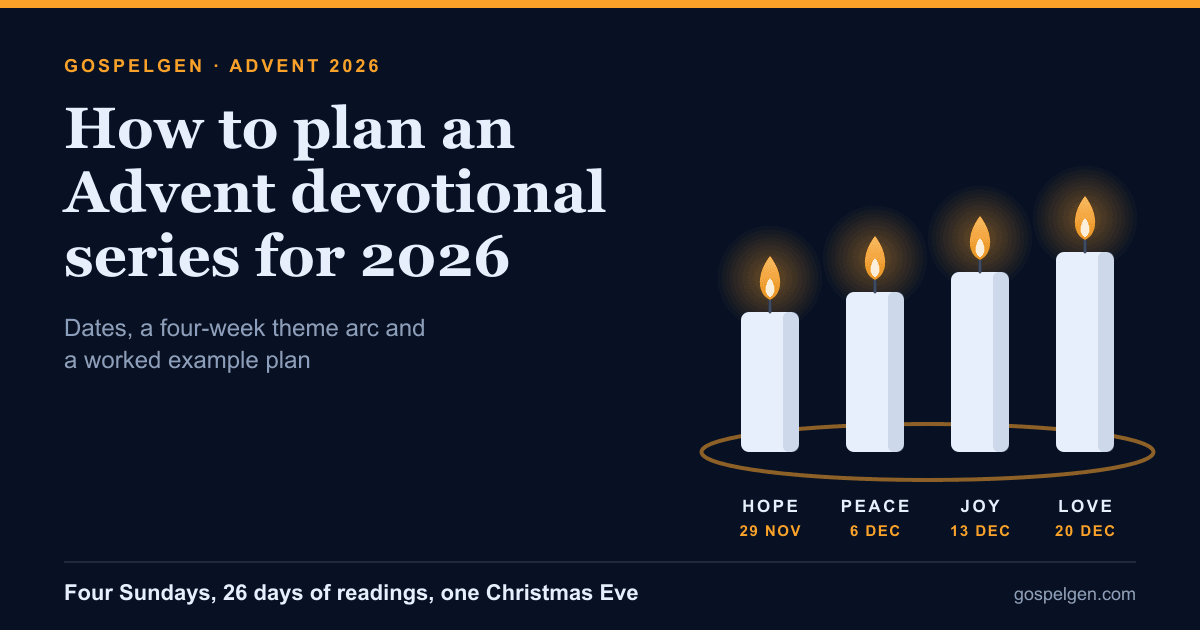
Advent 2026 begins on Sunday 29 November, and Christmas Day falls on Friday 25 December. That gives your church four Sundays and 26 days of daily readings, from the first Sunday through Christmas Eve. Starting in early November leaves time to write, check and print before the first candle is lit.
Why Advent deserves a plan
Advent comes from the Latin adventus, meaning coming. The season holds two comings together: Christ's birth at Bethlehem and his promised return. Paul writes that God's grace has already appeared in Christ and that we now wait for his appearing in glory (Titus 2:11–14, paraphrase). Advent lives in the space between those two appearings.
That is why Advent does not rush to the manger. Its readings make room for longing and lament, as in Isaiah 64:1–9 and Psalm 80:1–7, and for Jesus' call to stay watchful in Mark 13:24–37. A devotional series lets a congregation keep that rhythm together. When the same passage is open on kitchen tables and phone screens across the church on the same morning, Sunday's sermon has somewhere to land.
The 2026 calendar at a glance
- Sunday 29 November: first Sunday of Advent.
- Sunday 6 December: second Sunday of Advent.
- Sunday 13 December: third Sunday of Advent.
- Sunday 20 December: fourth Sunday of Advent.
- Thursday 24 December: Christmas Eve.
- Friday 25 December: Christmas Day.
Notice the short final week. Because Christmas falls on a Friday, the fourth week of Advent runs only from Sunday 20 to Thursday 24 December: five days, not seven. If you write seven readings for every week, two will have nowhere to go.
If your church follows the Revised Common Lectionary, Advent 2026 begins Year B, the year that reads mostly from Mark's Gospel. The Roman Catholic Lectionary is also in Year B, though some of its Advent passages differ. Check your own church's table first, then build the daily readings around the Sunday texts so the devotional supports the sermons.
A workable four-week runway:
- Week of 2 November: choose the theme arc, the Sunday texts and the format (printed booklet, email, text message or app), and assign writers.
- Week of 9 November: draft and edit the daily entries.
- Week of 16 November: check references and quotations, clear permissions, finish translations and send files to print.
- Sunday 22 November: hand out booklets. Many churches keep this last Sunday before Advent as Christ the King or Reign of Christ Sunday.
If your church keeps US Thanksgiving on Thursday 26 November, have everything printed and scheduled before that week. Our church newsletter template has a simple structure for the announcement.
Choose a theme arc that fits your tradition
Hope, peace, joy and love is a common pattern for the four weeks and their candles, but it is not the only one. Some churches swap peace and love. Others name the candles for the prophets, Bethlehem, the shepherds and the angels. Many use three purple candles and a rose candle for the third Sunday, often called Gaudete Sunday, from the Latin for rejoice. Some use blue, and many add a white Christ candle in the center for Christmas Eve or Christmas Day.
Use the order your congregation already knows, so the booklet matches the wreath at the front of the church. Children and visitors notice when the two disagree. If your church does not use a wreath or follow the church year closely, the same four weeks of Scripture about Christ's coming still work without the candles.
A worked example: one fictional church's plan
Example Church does not exist. It is a fictional congregation with families and a midweek small group, invented for this guide. Its plan shows one way to fit the 2026 calendar; it is not a report about a real church or a prescribed lectionary. The Sunday passages follow Revised Common Lectionary Year B, and the daily readings were chosen to suit each week's theme.
Each daily entry follows the same pattern:
Date: Tuesday 1 December 2026 (Advent week 1: Hope)
Read: Isaiah 11:1–10
Reflect: [up to 150 words in your church's voice]
Ask: [one question a child or a newcomer could answer]
Pray: [one or two sentences]
Translation for any quotation: [name it]
Reviewed by: [name and date]
Week 1: Hope (29 November to 5 December)
- Sunday: Isaiah 64:1–9 and Mark 13:24–37.
- Monday to Saturday: Psalm 80:1–7; Isaiah 11:1–10; Jeremiah 33:14–16; Romans 15:4–13; Lamentations 3:19–26; 1 Corinthians 1:3–9.
- Reflection prompts: What are you waiting for that only God can give? What would honest lament sound like in your prayers this week?
- At home: light the first candle at dinner, read three or four verses aloud and let everyone name one thing they are waiting for.
- Small group: read Mark 13:24–37 together and ask what faithful waiting looks like on an ordinary Tuesday.
Week 2: Peace (6 to 12 December)
- Sunday: Isaiah 40:1–11 and Mark 1:1–8.
- Monday to Saturday: Psalm 85:8–13; Isaiah 2:1–5; Micah 5:2–5; Luke 1:68–79; John 14:25–27; 2 Peter 3:8–15.
- Reflection prompts: Where do you need God's comfort more than a quick fix? Who might you need to make peace with before Christmas?
- At home: pray together for one place in the world where there is war, and for one relationship closer to home.
- Small group: talk about why Mark opens the good news with John the Baptist's call to repent, and what repentance has to do with peace.
Week 3: Joy (13 to 19 December)
- Sunday: Isaiah 61:1–4, 8–11 and John 1:6–8, 19–28.
- Monday to Saturday: Psalm 126; Isaiah 35:1–10; Zephaniah 3:14–20; Luke 1:39–45; Luke 1:46–55; 1 Thessalonians 5:16–24.
- Reflection prompts: Where have you seen God restore something you thought was lost? How is joy different from a good mood?
- At home: write a list of God's good gifts from this year and keep it beside the wreath.
- Small group: read Mary's song in Luke 1:46–55 and notice the reversals she sings about.
Week 4: Love (20 to 24 December)
- Sunday: 2 Samuel 7:1–11, 16 and Luke 1:26–38.
- Monday to Wednesday: Matthew 1:18–25; 1 John 4:7–12; Galatians 4:4–7.
- Thursday, Christmas Eve: Isaiah 9:2–7 and Luke 2:1–20.
- Reflection prompts: When has God kept a promise to you in a way or at a time you did not expect? Who could you love in a practical way before Friday?
- At home: leave the Christ candle unlit until Christmas Eve, then light it after reading Luke 2:1–20.
- Small group: most groups will not meet this week, so the leader sends a short reflection on 1 John 4:7–12 instead.
The Christmas Eve tie-in
The booklet's last entry uses the same passages as Example Church's Christmas Eve service, so people who have read along all month hear them read aloud together. The final page invites readers to bring the booklet to the service, where the Christ candle is lit, and adds one optional reading for Christmas Day: John 1:1–14. Visitors on Christmas Eve receive a card with that reading and an invitation to worship on Sunday 27 December.
Adapt the plan for the people you serve
- Children: shorten readings to a few verses, ask concrete questions and give them something to do, such as drawing the day's scene.
- Youth: send the reference and one question by text each morning, and invite a few students to write entries with an adult editor.
- People new to the Bible: explain how to read a reference (Luke 1:26–38 means the Gospel of Luke, chapter 1, verses 26 to 38) and define words like Advent and Magnificat.
- Older and homebound members: mail large-print copies and pair them with a weekly phone call.
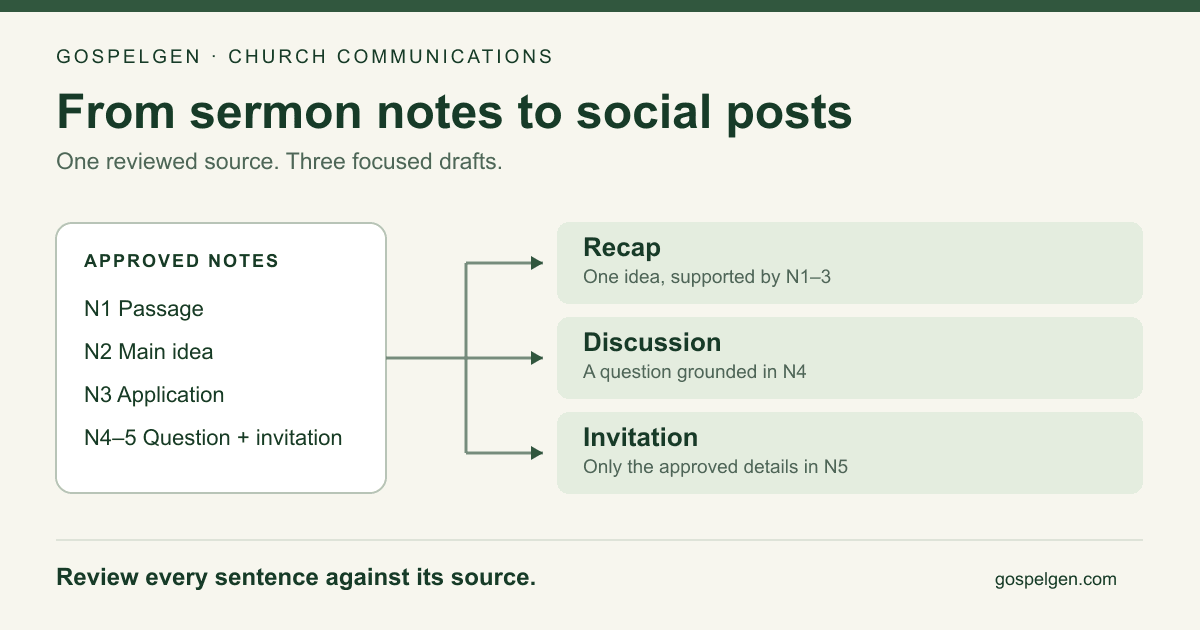
- Small groups: build one discussion a week on the Sunday passage instead of reviewing six daily readings. Our guide to turning a sermon into small-group discussion questions walks through the method.
Accessibility and multilingual congregations
Plan formats as carefully as content. Offer a large-print edition and a digital version with proper heading styles that screen readers can follow, and never put the day's reading only inside an image. Record each entry as audio for people with low vision, people who find reading hard and anyone with a long commute. Name each candle in words as well as color, so nobody has to tell purple from blue to follow along.
For multilingual congregations, give each language group the Bible translation it already reads, and ask a fluent speaker to review translated reflections rather than relying on machine translation alone. Keep one reference list for every edition, but check the numbering. Bibles that follow the Hebrew verse numbering, including the Luther Bible in German, number the Christmas Eve reading Isaiah 9:1–6 rather than 9:2–7 and Micah 5:2–5 as Micah 5:1–4, and many count a psalm's title as its first verse, so Psalm 80:1–7 becomes 80:2–8. Orthodox Christians prepare for Christmas with the forty-day Nativity Fast rather than Advent, and churches that keep the Julian calendar celebrate Christmas on 7 January, so their members may need different dates.
A review checklist before you print
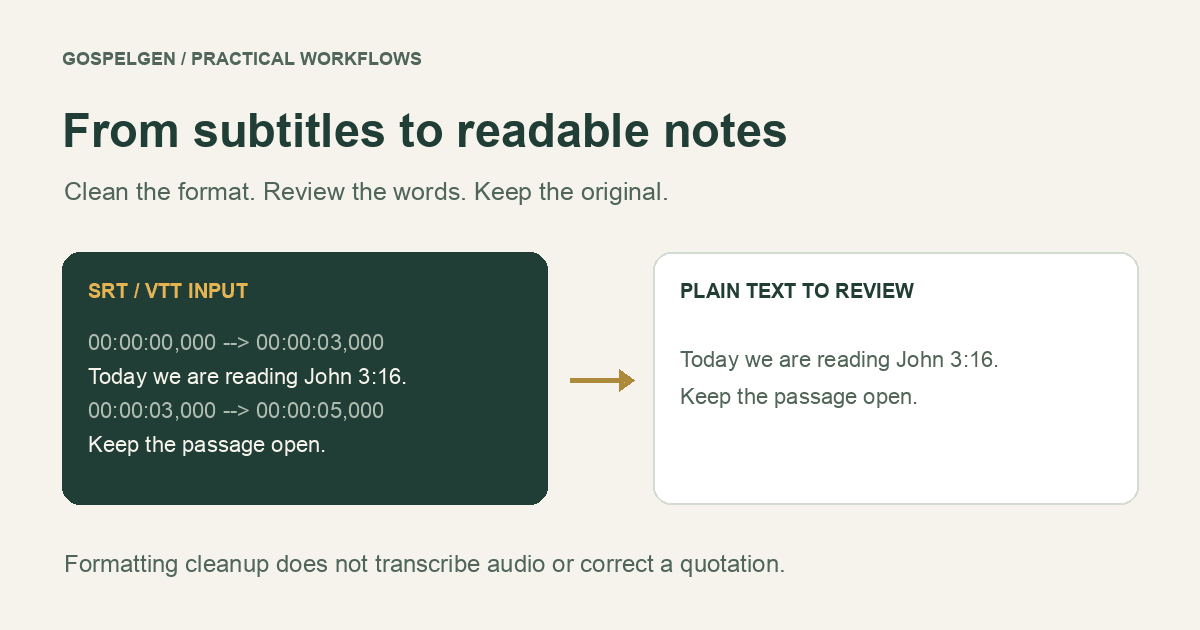
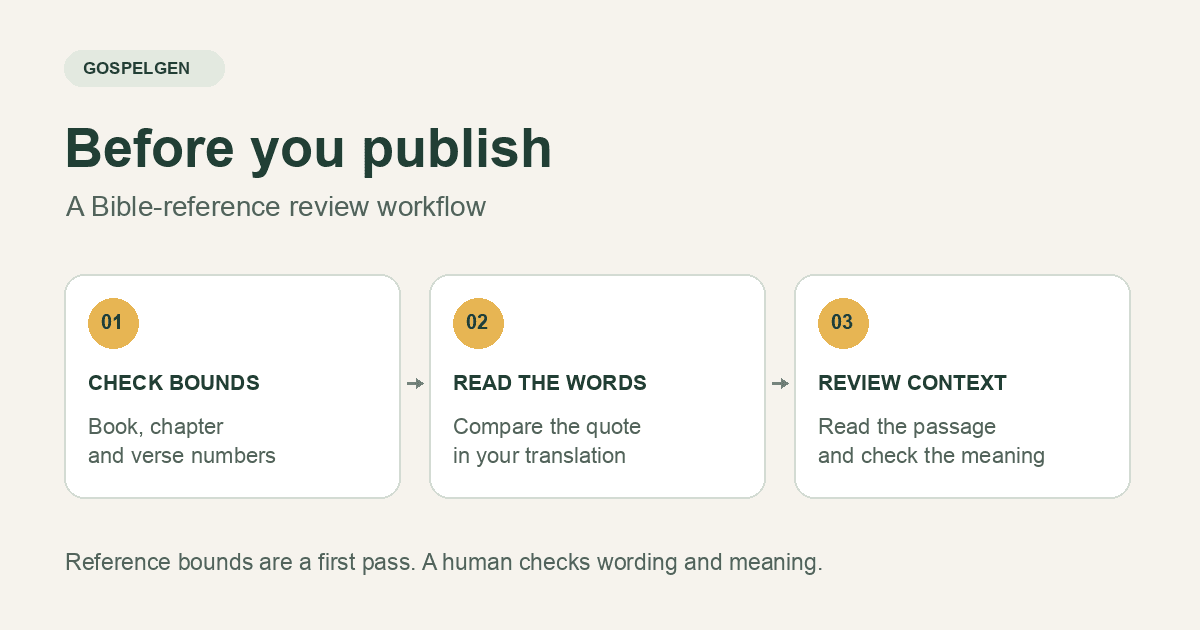
- Check every reference: the book, chapter and verse exist, and the passage is the one you meant. The free Bible reference checker compares numbering with standard English data in your browser; it does not check wording or interpretation.
- Verify every quotation word for word against the translation your church uses, name that translation, and follow its publisher's rules on quotation limits and copyright notices.
- Label paraphrases as paraphrases, and keep them out of quotation marks.
- Confirm the dates: four Sundays, a five-day final week and Christmas Eve on Thursday 24 December.
- Use only images your church owns, has licensed or has permission to publish, and get consent before printing photos of identifiable people, especially children.
- Before printing or projecting song lyrics, confirm that your church's license covers both the use and the song.
- Ask a pastor or elder to read the whole booklet for theology, tone and any promise it should not make.
- Test every link and QR code, then record who approved the final version.
Our guide on how to check Bible references explains the difference between a valid reference and a verified quotation.
Where GospelGen can help
You can run this whole process with a word processor. For a first draft, GospelGen's devotional plan generator writes a plan of 7, 14, 21 or 30 days, with a reading, reflection and prayer for each day and optional questions or journaling prompts, in the output language and Bible translation you choose. A seven-day plan for each Advent week fits the 2026 calendar; trim the fourth to five days. The worship flow builder can sketch an order of service for each Sunday, and the social media generator can draft weekly reminders. These generators run in a signed-in account and use credits.
Whoever or whatever writes the first draft, the plan still needs your church's voice, the checks above and a pastor's final read before it reaches your people.
Ready to put these ideas into practice? Start with GospelGen — free.
Try GospelGen Free →