October 29, 2026 · 6 min read · By GospelGen Team
A sermon outline template: from passage to practical teaching
Download a blank TXT worksheet, develop a passage-based main idea and supported teaching points, then review your outline before preaching.
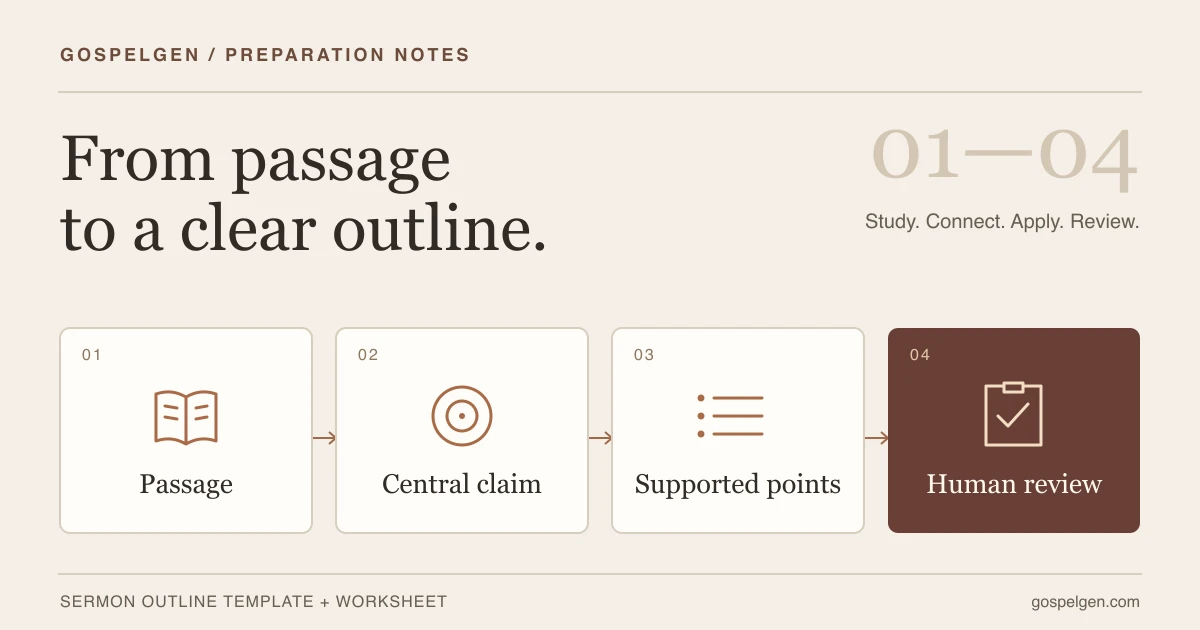
A sermon outline template organizes your study into a passage, one central claim, supported teaching points, practical applications and a conclusion. Begin with the passage in context, then use the outline to make its argument clear to your listeners. A useful template gives your preparation a structure while leaving room for the text to shape the sermon.
Start with the free blank sermon outline worksheet (TXT). Save it in your own text editor or print it. It includes preparation fields, three adaptable point sections, discussion questions and a human review checklist. No account or AI request is needed.
1. Set the passage and its context
Write down the passage boundaries and the Bible edition you will use. Read the surrounding paragraphs before deciding what this section means. Identify the writer or speaker, original audience, literary setting and place in the wider argument. Record questions you still need to study instead of filling gaps with a confident guess.
Describe your listeners and the purpose of this teaching. Children, a youth group and a mixed congregation may need different explanations and illustrations. Keep the passage’s meaning distinct from the ways you explain it to each audience. Audience needs help you choose clear language; they do not establish what the passage says.
2. Write one main idea
Complete this sentence in your notes: “This passage teaches that…” Aim for a claim someone could explain back, rather than a broad topic such as faith or service. Check whether your sentence accounts for the whole selected passage. If one section does not fit, reconsider your sentence or the passage boundaries.
3. Connect every point to its support
For each point, record the claim, specific verses, observations, explanation and application. Show how the verses support the claim. When you consult a commentary or historical source, keep its author, title and page or accessible link beside the note. Distinguish an observation in the text from your own inference or another writer’s interpretation.
The worksheet has three point sections as a starting layout. Use two, four or another structure when the passage calls for it. You can also develop one argument through several movements. Do not invent a third point to make the headings look balanced. Write transitions that explain how the ideas connect.
4. Develop an application listeners can understand
Ask what response follows from this particular passage and why. Describe a concrete action, attitude to reconsider or question to bring into prayer. Allow for different circumstances: an application about generosity should not assume everyone has the same income. Avoid promising an outcome the text does not promise or pressuring someone to disclose a private struggle.
Draft the introduction and conclusion once the main argument is clear. Open with an honest question or an illustration you have permission to use. End by drawing the points together and inviting a response grounded in the passage. A striking story should serve the teaching; it should not become its evidence.
A short preparation example: James 1:19–27
Read James 1:19–27 in the ESV on Crossway’s website alongside these notes. This original partial example uses paraphrase and editorial inference, not Bible quotations. It is an illustrative preparation exercise requiring pastoral review, not a complete exposition.
Possible main idea, an editorial inference: receiving God’s message should reshape everyday conduct.
Point 1 — Examine how you receive instruction. Verses 19–21 connect listening, speech, anger and receptiveness. Possible application: pause during a disagreement and consider whether your response leaves room to listen.
Point 2 — Follow understanding with action. Verses 22–25 contrast attention without response with persistent practice. Possible application: identify one response to the passage and revisit it during the week.
Point 3 — Look at visible conduct. Verses 26–27 address speech, care for vulnerable people and personal integrity. Possible application: plan appropriate practical help through an existing care ministry.
Still to study: how these movements fit James’s wider argument, how your church explains the passage and whether the applications follow without reducing the teaching to a task list.
5. Review before teaching
Read the passage again beside the completed outline. Can you trace every point to its support? Check quotation wording in your named Bible edition, verify outside facts and remove invented testimony. Ask a qualified reviewer in your church to assess interpretation and theology. Read the outline aloud to catch confusing transitions and allow time for explanation.
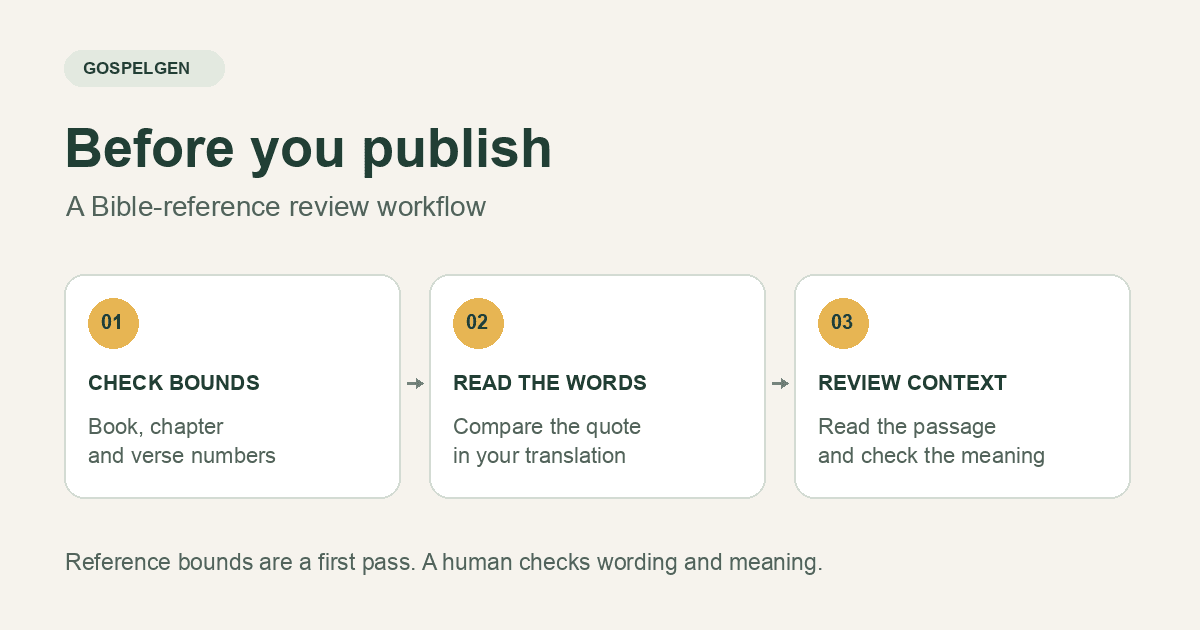
The local Bible Reference Checker can check recognized book, chapter and verse numbering against its available data. It does not verify quotation wording, interpretation or theology. A valid reference still needs to support the claim beside it.
Common questions
What format should a sermon outline use?
Use a format you can follow while speaking: passage and main idea, introduction, supported points with applications, and conclusion. Keep fuller research notes separately if they interrupt the flow. The TXT worksheet is editable in an ordinary text editor.
Does every sermon need three points?
No. Three points can be a convenient planning aid, but the passage and teaching purpose should determine the structure. Adapt the worksheet rather than squeezing the text into equal sections.
Can AI help draft the outline?
Optionally, use the free Sermon Outline Generator for a starting draft. It shares three online requests per daily visitor identifier with the transcript extractor and content kit, with a 30-second cooldown and global capacity limits. An admitted request counts even if it fails. Leave private pastoral details out and review the draft yourself.
After reviewing your outline, use the small-group discussion guide to develop questions from the same notes.
Find the worksheet and related preparation tools in the free ministry tools collection.
Ready to put these ideas into practice? Start with GospelGen — free.
Try GospelGen Free →